Gutters in salt air corrode at their weak points first: cut edges, seams and steel screws. Homes within about two miles of Charlotte Harbor or Lemon Bay can age their gutters up to twice as fast as homes inland. Stainless fasteners, seamless runs and a freshwater rinse every few months close most of that gap.
Live within a mile or two of the water in Punta Gorda or Englewood, and your gutters are aging faster than the same gutters ten miles inland. Salt air is the reason, and gutters in salt air age on a different clock. It settles on aluminum as a fine, invisible film, holds moisture against the metal, and slowly eats through the protective finish, starting at the cut edges, the fasteners, and the seams. You won’t see it happening for years. Then one season you’ll notice chalky white patches, pitting, or a hanger that’s rusted loose, and the damage is already done.
We’ve hung gutters on homes from Charlotte Harbor to Manasota Key for over three decades, and the difference between a coastal system and an inland one is real. The good news is that it’s manageable if you know what salt actually does, what to watch for, and which small habits add years to the metal.
What salt air actually does to a gutter
Aluminum doesn’t rust the way steel does, which is why it’s the right material for Florida in the first place. What it does instead is oxidize. Normally that’s harmless. Aluminum forms its own thin oxide layer that protects the metal underneath, and the baked-on paint finish adds another barrier on top.
Salt changes the math. Salt crystals pull moisture out of the air and hold it. A salty film on your gutters keeps the surface damp long after the morning fog burns off. Damp, salty metal corrodes many times faster than dry metal, and the paint finish that protects the flat surfaces does nothing for the places where raw aluminum is exposed: the cut ends, the drilled holes where hangers and screws go through, and the inside of every seam.
That’s why coastal corrosion doesn’t show up evenly. It starts at the details (the end caps, the miters, the fastener heads) while the long runs still look showroom-fresh from the street.
There’s a second problem most homeowners never think about: the hangers and screws themselves. If an installer used plain zinc-plated steel fasteners near the coast, those will rust years before the aluminum shows any distress. A rusted fastener streaks orange down the fascia, loses its grip, and lets the gutter sag. A sagging coastal gutter collects salty standing water, which accelerates everything else.
How close to the water does this matter?
There’s no hard line, but here’s what we see on actual homes in our area.
Within about half a mile of open water (Charlotte Harbor frontage, Manasota Key, the canals off Lemon Bay), salt exposure is constant. Finishes chalk noticeably faster, and bargain-grade fasteners can show rust in as little as three to five years.
From half a mile to roughly two miles out (most of Punta Gorda Isles, downtown Englewood, the neighborhoods along Placida Road), exposure is moderate. The onshore breeze still delivers salt daily, but rain rinses more of it off. Problems typically show up at the ten-year mark instead of the five-year mark, and almost always at seams and fasteners first.
Beyond a few miles inland (most of Port Charlotte and North Port), salt stops being the main factor. Sun, rain volume and debris take over as the things that age a gutter.
One wrinkle worth knowing: homes behind barrier islands but facing open canals often test closer to the “waterfront” category than their distance suggests. Salt travels up the canals with the breeze. If you can smell the water from your lanai on a windy day, your gutters can feel it too
The warning signs, in the order they appear
Chalking. Run a finger along the gutter face. A white powdery residue on your fingertip means the paint finish is oxidizing. That’s the first stage, cosmetic for now, but a sign the protective layer is thinning.
White crust or blistering at cut edges and end caps. This is aluminum oxide building up where raw metal meets salt. It looks a little like dried toothpaste. At this stage the metal is actively corroding, but there’s usually plenty of life left if the exposure is reduced.
Orange streaks below screw heads. That’s not the aluminum. It’s steel fasteners rusting. Left alone, they’ll fail, and the gutter run they were holding will start pulling away from the fascia.
Pitting. Small dark pockmarks in the metal surface, usually inside the gutter where salty water has pooled. Pitting is the point of no return for that section. It only gets deeper, and eventually it becomes a pinhole leak.
If you’re seeing the first two, maintenance will hold the line. The second two mean it’s time to have someone take a proper look.
What actually protects coastal gutters
The right fasteners, from day one. Stainless steel screws and heavy-duty hidden hangers cost a little more per foot and are worth every penny within sight of the water. If your current system was installed with plated-steel fasteners, swapping them is a modest job that prevents the most common coastal failure we see.
Fewer seams. Every seam is exposed raw metal plus trapped moisture, which is exactly what salt loves. Seamless runs with only the corners joined give salt dramatically less to work with. It’s one of the reasons seamless gutters make even more sense on Punta Gorda and Englewood homes than inland.
A freshwater rinse a few times a year. This is the cheapest protection there is, and almost nobody does it. When you rinse the pollen off the lanai or wash the car, put the hose on the gutters for five minutes: faces, underside, and inside the trough. Fresh water dissolves and carries off the salt film that rain often doesn’t reach, especially on the underside and the leeward face. Waterfront homes benefit from a rinse every month or two; a few streets back, quarterly is plenty.
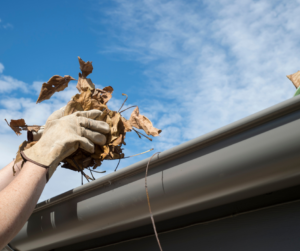
Keep them flowing. Standing water in a coastal gutter is salty standing water. Clogged gutters anywhere are a problem; near the coast they’re a corrosion accelerant. A regular cleaning and maintenance schedule matters more here than anywhere else in the county.
Touch up cut edges. When we install near the water, we seal exposed cut ends. If you can see bare, shiny aluminum at an end cap or around a downspout outlet on an older system, a dab of matching touch-up paint over clean, dry metal buys real time.
Frequently asked questions
How much shorter is a gutter's life near the coast?
Neglected, a waterfront system can age twice as fast, showing at year 8–10 what an inland system shows at 20. Maintained (rinsed, cleaned, stainless fasteners), the gap nearly closes.
My gutters have white chalky patches. Do they need replacing?
Usually not. Chalking and light oxide crust are early-stage and manageable. Pitting and pinhole leaks are the signs that a section is done.
Do gutter guards help or hurt near salt water?
They help. Less debris means less trapped, salty moisture. Choose aluminum or stainless mesh; plastic guards get brittle in coastal sun faster than the gutters corrode.
Can you just replace the rusted screws?
Yes, and it’s one of the smartest small jobs a coastal homeowner can order. Swapping rusted fasteners for stainless before they fail protects the fascia and avoids a sag that would damage the gutter itself.
What about "salt-proof" gutters?
You’ll see copper and heavy-gauge aluminum marketed as coastal upgrades. Copper genuinely shrugs off salt. It just costs several times as much and develops a patina that not everyone wants. For most homes here, the honest answer is simpler: standard quality aluminum, thicker gauge if the budget allows, stainless fasteners, minimal seams, and the rinse-and-clean habits above. That combination routinely gets coastal systems to a normal lifespan without exotic materials.